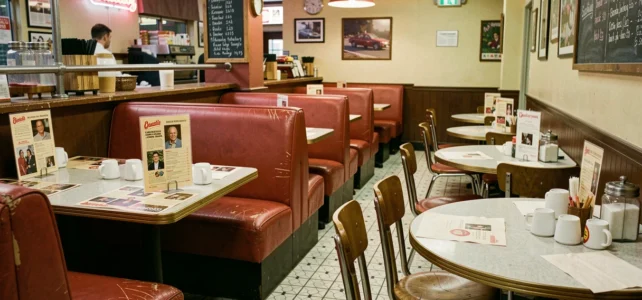
Between the 1980s and the early 2000s, France witnessed the birth and subsequent disappearance of several restaurant chains that shaped the eating habits of an entire generation. These brands, often linked to specific concepts (grill, self-service cafeteria, themed dining), ultimately closed due to a combination of economic changes, shifts in consumption patterns, and increasing regulatory constraints.
Understanding their trajectory also means reading between the lines the evolution of the French relationship with dining out.
Self-Service Cafeterias and Grills: An Economic Model That Became Fragile
The concept of self-service cafeteria long relied on a simple principle: to offer complete meals at moderate prices in high-traffic commercial areas. Brands like Casino Cafétéria, Flunch (in its original form from the 1970s-1980s), or Jacques Borel cafeterias embodied this model. The customer would assemble their tray, choose from dishes prepared in large quantities, and pay at the register before sitting down.
This format worked as long as the quality-price ratio remained unbeatable. With the rise of fast food on one side and bistro-type establishments on the other, the cafeteria found itself without a clear positioning. Too slow to compete with fast food, too impersonal to attract a clientele seeking authenticity.
Among the former restaurant chains that have disappeared, roadside grills occupy a special place. Courtepaille, long synonymous with grilled meat over a wood fire on major roads, went through several restructurings before losing a large part of its network. The model of the highway grill assumed a regular flow of travelers, a flow that carpooling, telecommuting, and the multiplication of competing dining areas have gradually diminished.
Disappeared Themed Restaurants: Hippopotamus, Buffalo Grill, and the End of an Era
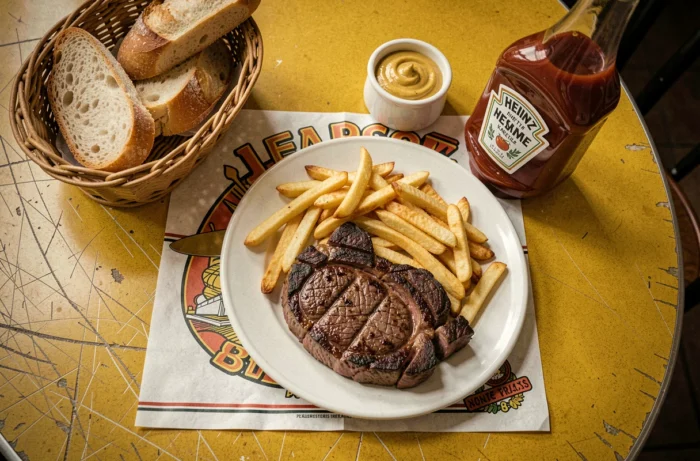
The themed restaurants of the 1990s relied on a strong promise: an identifiable decor, a clear menu, and a family atmosphere. Hippopotamus, with its checkered tablecloths and beef cuts, long embodied the French steakhouse. The chain gradually reduced its network until it had only a handful of locations left, before disappearing from the landscape.
The case of these brands illustrates a recurring trap. A strong concept at launch becomes a straitjacket when the market evolves. The fixed menu, dated decor, and lack of renewal in plant-based or local offerings have rendered these restaurants disconnected from the expectations of a younger clientele, more concerned with traceability and food diversity.
Regulatory Constraints and Compliance Costs
The disappearance of these networks cannot be explained solely by consumer tastes. Each franchised restaurant remains a distinct legal entity. Regulations require that at least one person trained in food hygiene (HACCP) be present in each establishment. A centralized certificate at the franchisor level is not sufficient.
Since decree n° 2025-922 of September 6, 2025, training organizations in food hygiene must be authorized by the regional prefect, with a mandatory pedagogical framework. This requirement increases the cost structure for fragile multi-site networks and complicates the takeover or reopening of restaurants under a historic brand.
- Each point of sale must have its own HACCP-trained staff, which multiplies training costs across the network.
- Bringing aging premises up to health and accessibility standards represents heavy investments for already struggling franchisees.
- The AGEC law has required since July 2021 the provision of takeout containers (doggy bags) in all restaurants, adding an additional logistical constraint.
Nostalgia for Disappeared Chains: Why These Brands Still Resonate
The emotional dimension of these closures far exceeds gastronomy. For many French people, these chains are associated with specific memories: Sunday family meals at the cafeteria after shopping, a child’s birthday at a themed restaurant, steak-frites on the vacation highway.
These brands served as geographical and social landmarks. They punctuated commercial areas and national roads, creating a reassuring familiarity. Their disappearance often leaves empty premises in already fragile shopping centers, reinforcing the impression of decline in certain suburban territories.
The Weight of Franchising in the Mechanism of Disappearance
Most of these chains operated on a franchise or branch model. When the network head faces financial difficulties, the domino effect is swift. Franchisees lose access to the brand, purchasing centers, and national advertising campaigns. Some attempt to continue under another name, but without the brand’s notoriety, traffic drops sharply.
Recent case law in franchise law has also strengthened the franchisor’s pre-contractual information obligations. A fragile network seeking to recruit new franchisees must now provide detailed financial data, which discourages candidates when the figures are declining.
Restaurant Chains in France: A Reshaped but Not Empty Landscape
The disappearance of these brands has not created a void. Other formats have taken over: premium fast food, bowls and poke, accessible bistronomy, dark kitchens. The market has fragmented rather than concentrated.
- High-end fast food concepts (artisan burgers, wood-fired pizzas) attract customers who once frequented the grills.
- Delivery platforms have redistributed flows, making physical location less decisive than before.
- Local estaminets and bistros now rely on social media to attract nearby clientele, replacing national notoriety with targeted local visibility.
The disappeared restaurant chains in France tell a story of cycles. A concept is born, attracts, standardizes, then freezes while the market continues to advance. Premises become available, and other projects move in. For those who experienced them, the persistent memory of a Formica meal tray or a ribeye ordered under a red neon light remains.