
The global technology market is expected to reach $1.4 trillion by 2026 according to projections reported by AFP. Behind this figure, changes are occurring on several simultaneous fronts: European AI regulation, a race for specialized models, and a redesign of cloud infrastructures. The landscape shaping up this year is not just a list of gadgets. It involves industrial choices, regulatory trade-offs, and transformations in how users interact with their devices on a daily basis.
EU AI Act and mandatory transparency: what changes for high-tech products
As of August 2, 2026, the transparency obligations of the EU AI Act are fully applicable. Any chatbot, voice assistant, or conversational agent intended for European users must clearly announce that it is an artificial intelligence. The rule extends to synthetic content: images, videos, and texts generated by AI must carry machine-readable labeling.
This requirement directly affects smartphones, connected TVs, and smart speakers sold in the European market. Samsung, Apple, and Amazon are adapting their interfaces to incorporate these notifications, visibly altering the user experience.
Analyses published on the tech section of Greg From Paris regularly detail these regulatory developments and their translation into everyday products.
On the other hand, the so-called “high-risk” regime (automated recruitment, credit scoring, biometrics) has been officially postponed to December 2027 for autonomous systems, and to August 2028 for those embedded in regulated products. This delay, confirmed by the Digital Omnibus on AI regulation adopted in the summer of 2026, creates a two-speed situation: transparency rules are already in effect, while the heaviest constraints remain pending.
Specialized AI models and multi-agent systems: the end of the one-size-fits-all model
Gartner has identified specialized language models among its strategic technology trends for 2026. The idea: instead of a single massive generalist model, companies are deploying models trained in specific domains (legal, medical, industrial) that consume fewer resources and produce more reliable results within their scope.
Anthropic, a key player alongside OpenAI, is pushing this logic. Field feedback varies on the actual capability of these specialized models to replace generalist solutions in all use cases. Some companies report notable performance gains, while others find that maintaining several parallel models generates unexpected complexity.
Orchestration by autonomous agents
Multi-agent systems represent a complementary turning point. Rather than a single assistant, multiple AI agents cooperate to accomplish a complex task: one searches for information, another verifies it, and a third writes the summary. Gartner places this architecture among the fundamental levers for IT departments.
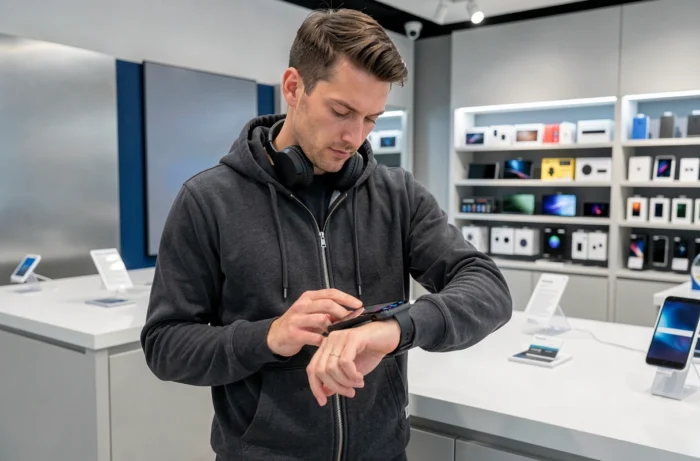
For the general public, this is gradually reflected in the assistants of smartphones and smartwatches. Samsung’s Galaxy Watch or the Apple Watch incorporate AI layers capable of cross-referencing health data, calendars, and geographical context without consistently calling a remote server.
Edge AI and smartphones: local processing as a commercial argument
AI processing directly on the device (edge AI) is becoming a major differentiation axis. The stakes are twofold:
- Reducing latency by avoiding back-and-forth trips to the cloud, which improves the responsiveness of photo functions, real-time translation, or voice recognition on an iPhone or Galaxy
- Meeting the privacy requirements strengthened by the EU AI Act, as personal data remains on the terminal instead of passing through third-party servers
- Decreasing dependence on the network, a concrete argument in areas where 5G coverage remains uneven
The chips embedded in high-end smartphones of 2026 include dedicated blocks for neural computing whose power has significantly increased compared to the previous generation. This evolution enables uses that previously required a permanent connection.

Smartwatches and Bluetooth devices: a market that is segmenting
The smartwatch market illustrates an underlying trend: segmentation by use. Samsung with the Galaxy Watch and Apple with its Watch still dominate in volume, but competition is structuring around niches.
Health-oriented watches (blood pressure monitoring, rhythm disorder detection) are distinguished from models focused on sports or productivity. Low-energy Bluetooth remains the connection standard, but protocols are evolving to allow the transfer of larger health data without a notable impact on battery life.
Prices reflect this segmentation. The latest premium version of a Samsung or Apple watch is positioned significantly above entry-level models, with a gap that widens year after year. The available data does not yet allow for a conclusion on whether this premiumization strategy retains users or pushes them towards more affordable alternatives.
Confidential computing and security of connected objects
Gartner identifies confidential computing among its strategic trends for 2026. This technology encrypts data during processing, not just during storage or transfer. For Bluetooth connected objects that exchange health data with a smartphone, it provides an additional layer of protection that addresses the growing concerns of European users.
The regulatory framework is pushing in this direction. Manufacturers must now document how data is protected at every stage, from the sensor to the cloud. This requirement increases development costs but becomes a selling point in front of an increasingly informed public about the privacy of their personal data.
The year 2026 marks less of a spectacular break than a tightening of constraints around AI and data. The high-tech products that will stand out are those that translate these constraints into tangible features, not those that suffer from them as a hindrance.