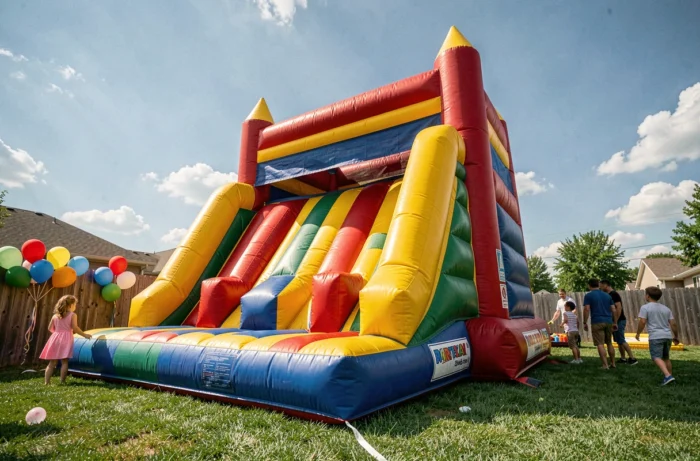
Renting an inflatable structure for a birthday party, a fair, or a village celebration raises more technical questions than it seems. Between the ERP classification of these installations, ground anchoring constraints, and the price differences among providers, what criteria truly weigh in on the success of renting an inflatable structure for an event?
ERP Classification Type SG: What Regulations Impose on Inflatable Structures
Most rental guides focus on the choice of model or the size of the area. They overlook a regulatory point that conditions the entire organization: inflatable structures hosting the public now fall under the type SG in the ERP classification (establishments receiving the public).
Chapter SG precisely regulates the authorized uses under an inflatable structure. It is prohibited to install sleeping quarters, no teaching, no permanent offices, no health establishments. The materials used are subject to strict limitations on calorific potential, and public evacuation rules apply fully.
For an organizer, this means that certain indoor activities (food stands, extended workshops, rest areas) cannot coexist with the inflatable structure without adapting the setup. Checking this point with the provider before signing the quote avoids surprises on the day, especially if the prefecture conducts an inspection.
You can also learn more about Diboo net regarding the obligations related to this type of rental.
Comparison of Criteria for Choosing an Inflatable Structure Based on Event Type
The right model depends less on personal taste than on measurable constraints. Here is a comparison that highlights the decisive parameters based on three common configurations.
| Criterion | Birthday (home) | School fair | Village festival / community event |
|---|---|---|---|
| Main age group | 3-10 years | 3-12 years | All ages |
| Number of simultaneous participants | Less than 10 | Several dozen | Continuous flow, sometimes several hundred |
| Required ground area | Average garden | Schoolyard or covered area | Public square or dedicated land |
| Suitable structure type | Classic inflatable castle | Obstacle course or slide | Combination of several structures |
| Regulatory constraint | Home insurance to be checked | Possible ERP declaration | Mandatory ERP classification type SG |
| Required supervision | Adult present at all times | Enhanced supervision | Dedicated staff or provider on-site |
The most underestimated gap concerns the actual ground area required. An inflatable structure requires a safety perimeter around it, which sometimes doubles the ground footprint compared to the dimensions stated in the rental catalog.
Anchoring and Installation: Costly Mistakes When Renting an Inflatable
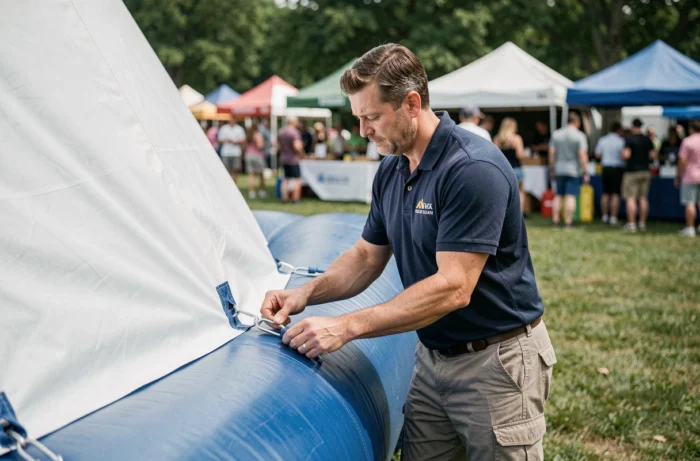
Ground anchoring remains the main cause of incidents with inflatable structures. A gust of wind is enough to move or lift a poorly secured installation. Serious providers use anchoring stakes driven into the ground (on natural terrain) or weights in water or sand (on hard surfaces).
- On grass or soil, metal stakes must reach a sufficient depth to withstand gusts, and their number depends on the surface area of the structure.
- On asphalt or slabs, weighting bags replace stakes, but their total weight must be proportional to the wind catch of the structure.
- An electric blower must run continuously throughout the duration of use: any power cut leads to rapid deflation and a risk of suffocation for children inside.
- The minimum distance between the structure and any obstacle (wall, tree, fence, power line) varies by model but is rarely less than two meters.
Asking the provider if they handle the installation and dismantling themselves is one of the questions to ask as soon as you request a quote. Some renters deliver the structure without assembly, which transfers the responsibility for anchoring to the organizer.
Insurance and Liability: Who Pays in Case of an Accident on an Inflatable Structure
The question of liability in case of an accident remains unclear for many organizers. The rental provider must provide an insurance certificate covering the structure itself. However, the civil liability of the event falls on the organizer.
For a private party, home insurance sometimes includes personal civil liability. For an associative or community event, a specific event insurance is necessary. Ensure that the contract explicitly mentions the presence of inflatable structures, as some policies exclude mechanical games or temporary installations.
The provider must also be able to present a certificate of conformity to the NF EN 14960 standard, which covers the design, manufacture, and maintenance of inflatable structures. This document certifies that the structure has been inspected and meets current safety requirements. Its absence is an immediate warning sign.
Inflatable Rental Quote: What Causes Price Variation Between Providers
Price differences between renters are rarely explained by the quality of the inflatable itself. The items that truly affect the quote are delivery, installation, the presence of an operator on-site, and whether insurance is included or not.
A provider offering a lower price but without installation or supervision actually transfers hidden costs to the organizer: assembly time, purchase or rental of a blower, and especially assumption of responsibility in case of an incident.
Comparing two quotes for inflatable rentals therefore requires listing the included services item by item, rather than just comparing the displayed price. Round-trip transport, installation time, provision of anchoring equipment, and insurance coverage must be explicitly stated in the document.
The choice of a provider for renting an inflatable structure relies less on the model than on the rigor of the proposed technical and regulatory framework. A detailed quote, a NF EN 14960 certificate, and installation carried out by the renter remain the three elements that separate a successful activity from a risky event.