
The Triban RC 120 is a road bike with an aluminum frame sold by Decathlon, while the GRVL 120 is its gravel counterpart. Both share an accessible entry-level philosophy, but their geometries, tires, and carrying capacities are designed for distinct uses. Understanding these technical differences helps in choosing the model suited to one’s actual practice.
Frame Geometry and Riding Position: What Separates Road from Gravel
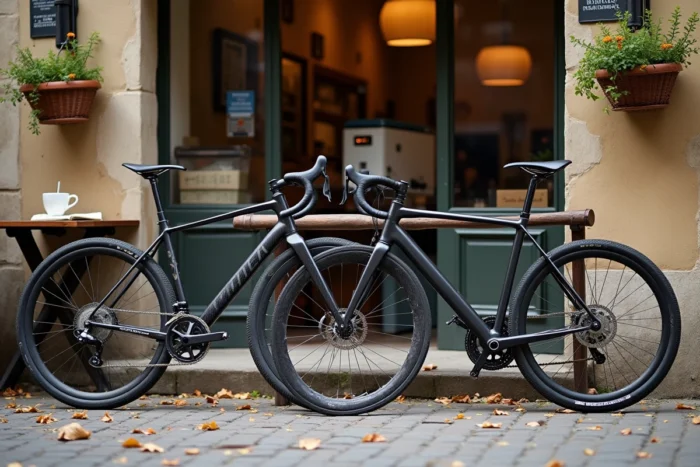
The fundamental distinction between the RC 120 and the GRVL 120 lies in the frame geometry. A road bike has a shorter wheelbase and a steeper head angle, which enhances responsiveness and agility during acceleration. The GRVL 120 lengthens the wheelbase and slightly opens the head angle to gain stability on loose terrain.
Specifically, on the RC 120, the position is more forward-leaning. The cyclist finds themselves bent over, with hands naturally on the hoods or in the drop of the handlebars. This posture improves aerodynamics on smooth roads but can strain the back over long distances if flexibility is lacking.
The GRVL 120 raises the handlebar position more. The more upright position reduces strain on the wrists and lower back, a notable advantage for daily commuting or rides exceeding two hours. Before making a decision, a comparison between the Triban RC 120 and the GRVL 120 detailing the geometric dimensions helps visualize these differences based on the chosen size.

Tires and Fork Compatibility: The True Limit of Versatility
The tires determine more than comfort: they define the terrains that can be tackled. The RC 120 rolls on moderately wide road tires, suitable for asphalt and smooth surfaces. The fork and rear stays limit the clearance available for fitting wider sections.
The GRVL 120 accepts significantly wider tires, capable of absorbing towpaths, compacted forest trails, or degraded roads. This capability radically changes the accessible playground without risking pinch flats or rubbing against the frame.
Tubeless or Inner Tube
The rims of the GRVL 120 are sometimes tubeless compatible depending on the model year, allowing for low-pressure riding without the risk of pinch flats. The RC 120 uses standard inner tube rims. For mixed city-trail use, the option to switch to tubeless setup offers a tangible reliability advantage on gravel.
Weight and Efficiency on the Road: Where the RC 120 Gains the Edge
The RC 120 weighs about 10.6 kg according to data published by BikeRadar, compared to around 10.9 kg in size M without pedals for the GRVL 120. The difference may seem modest on paper, but it is felt in three specific situations:
- Accelerations in the city, at traffic lights, and when exiting roundabouts, where every gram counts in acceleration
- Prolonged climbs with regular elevation, where the accumulated weight of the frame and heavier gravel tires penalizes the pace
- Cruising speed on flat terrain, where the thinner tires of the RC 120 generate less rolling resistance
On smooth roads, the RC 120 is faster and more efficient than the GRVL 120. This is not a matter of opinion but of physics: less mass, less contact surface, less friction.
Cargo Capacity and Accessories: Luggage, Fenders, Racks
The GRVL 120 features inserts and mounting points for racks and fenders. This detail, often overlooked in comparisons, changes the game for utility use. A commuter carrying a shopping bag or riding in the rain needs these mounts.
The RC 120 does not offer the same accessory capacity. Attaching a fender or rack requires adapters, sometimes resulting in an unstable outcome. For commuting or light bikepacking, the GRVL 120 is the logical choice.
Camping or Short Trip Use
With frame and saddle bags, the GRVL 120 can serve as a travel bike for a few days without overloading the structure. The RC 120 is not designed for this use. Its short stays and lack of mounts make loading precarious beyond a compact saddle bag.
End of the Triban Brand: Availability and Parts After 2024
Since 2024, Decathlon has reorganized its brands. Triban is disappearing in favor of Van Rysel for road and combinations of Van Rysel, BTWIN, and Rockrider for gravel and versatile bikes. The RC 120 and the GRVL 120 are therefore models in brand end-of-life.
This repositioning has a direct consequence: future range developments, component updates, and after-sales support will be under different names. Standard spare parts (brakes, derailleurs, cables) remain available as they come from third-party suppliers. Specific frame components (derailleur hanger, wheel axle) should be checked for stock before purchase.
- Check the availability of the specific derailleur hanger for the chosen model
- Ensure that replacement rims match the braking standard (disc)
- Anticipate that any potential upgrade of fork or wheels will be with Van Rysel or generic references
The RC 120 is suitable for cyclists who ride almost exclusively on asphalt and seek performance at a low price. The GRVL 120 targets those who want a single bike for the road, trails, and daily transport. The terrain of play takes precedence over the technical specifications: defining one’s usual routes before comparing components avoids a purchase misaligned with actual practice.