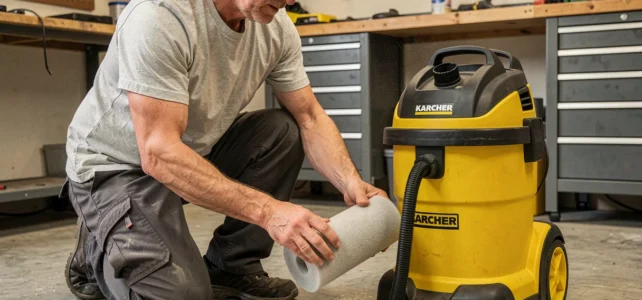
The flat pleated filter of the Kärcher WD4 is the part that endures the most effort: fine construction dust, sawdust residue, dirty water splashes after washing the car.
When suction power drops, the common reflex is to tap the filter against a hard surface or quickly rinse it under the tap. These two actions, repeated without method, damage the folds of the filter media and only restore a fraction of the initial capacity.
A cleaning protocol adapted to the type of dirt (dry or wet) prolongs the filter’s lifespan and maintains consistent suction, use after use.
Dry unclogging or rinsing: two distinct cleaning logics
Kärcher now distinguishes between two approaches for maintaining the filters of its wet and dry vacuums. The first relies on air pulse unclogging: on models equipped with a dedicated button, a press sends compressed air through the filter media to dislodge dust embedded between the folds. The WD4 does not have this automated function, but the principle can still be applied manually.
Specifically, after each dry dust job (sanding, wood cutting, vacuuming cold ashes from a stove), removing the pleated filter and blowing from the inside out with a compressor set to low pressure is enough to expel the majority of particles. The classic tapping against a trash can also works, provided you hit the metal part of the frame and not the filter’s pleats.
Before attempting to clean the Kärcher WD4 vacuum filter through systematic rinsing, it is important to understand that water is only useful when dust forms a compact crust (plaster, cement, flour) that cannot be dislodged by air alone. Rinsing introduces an additional constraint: drying.
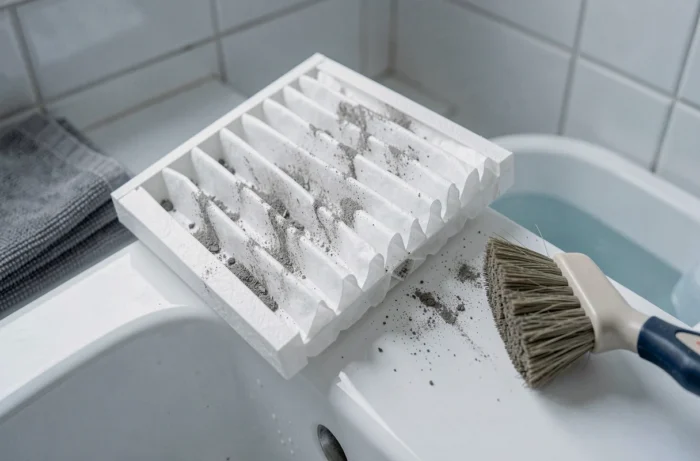
Drying the Kärcher WD4 filter: the constraint that quick guides minimize
The latest recommendations from vacuum manufacturers converge on one point: a wet filter should never be reinstalled. The reason is twofold.
A still-wet filter clogs within minutes as soon as it comes into contact with dry dust, creating an impermeable layer. Residual moisture trapped in the tank can also generate mold and persistent odors that contaminate each subsequent suction.
The necessary drying time depends on the ambient climate and the thickness of the media. Kärcher and other manufacturers mention a minimum complete drying time of twenty-four hours in a ventilated area, away from direct sunlight. In practice, during humid days or in a poorly ventilated garage, this timeframe can be extended.
For users who use the WD4 daily (workshop, ongoing construction), having a second pleated filter as a spare allows for alternating between the two without interrupting work. The rinsed filter dries while the clean, dry filter is in use.
Pleated filter, filter bag, and foam: the role of each element in the WD4 tank
The WD4 uses a flat pleated filter positioned above the tank, but it can also operate with a paper or non-woven filter bag placed inside the tank. These two elements do not serve the same purpose and do not substitute for one another.
- The flat pleated filter protects the motor from fine particles and water. It is mandatory, regardless of the suction mode (dry or wet). Its regular cleaning directly affects suction power.
- The filter bag (cotton or triple-layer paper) is placed in the tank for dry dust suction. It captures coarse debris before they reach the pleated filter, significantly reducing the frequency of cleaning for the latter.
- When vacuuming liquids, the bag must be removed. Only the pleated filter remains in place. After each water suction, empty the tank and rinse the filter if any residues have settled.
Using a filter bag for dust work is the simplest way to protect the pleated filter. Users who vacuum without a bag notice a much faster clogging of the pleated filter, sometimes after just one sanding session.
Filter cassette and contactless replacement
Kärcher highlights on its recent models a removable filter cassette system that allows for changing the filter without touching the accumulated dirt. On the WD4, the pleated filter is unlocked by rotating the fastening system located under the motor head. The action is quick, but care must be taken not to shake the filter above the open tank, lest dust be redeposited inside.
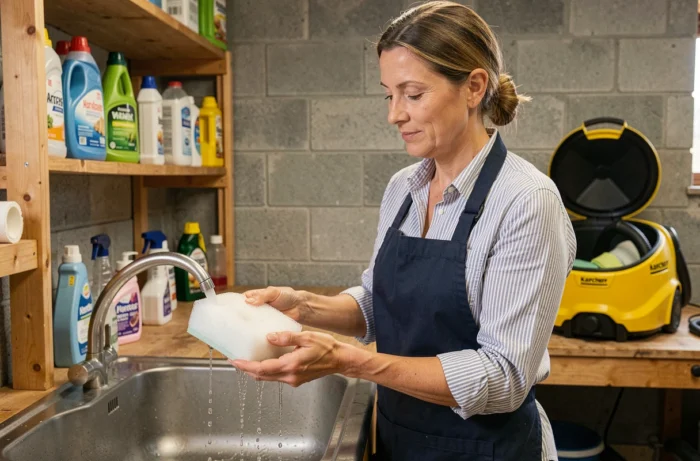
Filter cleaning frequency for the WD4 based on the type of work
General guides often propose a fixed schedule (weekly, monthly). In reality, the frequency depends entirely on the type of material being vacuumed. Here are the situations that require immediate cleaning of the pleated filter:
- After vacuuming fine dust (plaster, cement, wood flour): clogging is almost instantaneous without a filter bag. Clean the filter dry or by rinsing after each use.
- After vacuuming dirty or loaded water (flooded garage floor, terrace cleaning): rinse the filter and let it dry completely before reuse.
- For regular vacuuming (household dust, wood shavings, fine gravel with the filter bag in place): a dry unclogging every four to five uses is generally sufficient to maintain suction power.
Kärcher recommends for some of its filter sets cleaning the foam filter and the motor protection filter after each use. The WD4 does not have a separate foam filter, but the principle remains valid: the more intensive the use, the closer the maintenance should be.
Signs of a filter at the end of its life
A pleated filter that does not regain its suction power after a complete cleaning (blowing, then rinsing, then drying) has likely reached its limit. Deformed, torn, or hardened folds due to limescale deposits no longer filter properly. At this stage, replacing it with an original Kärcher flat pleated filter is the only reliable option. Compatible filters from third-party brands exist, but field reports vary on their durability and fine dust sealing.
The filter of the WD4 remains a consumable. Proper maintenance delays its replacement by several months, sometimes an entire season of work. Neglecting it turns a powerful vacuum into a noisy fan that picks up nothing.