
Strengthening family bonds on a daily basis is not about accumulating activities, but about the quality of the interactions they generate. We observe that families who explicitly name the strengths of each member before choosing an activity achieve significantly higher cooperation and satisfaction. This prior framing transforms a simple leisure activity into a relational lever.
Name the strengths of each member before choosing a family activity
Most guides offer lists of activities without ever addressing the prerequisite: identifying who listens, who organizes, who makes others laugh, who calms. Each person has between three and five dominant strengths, sometimes called “signature strengths.” Making these visible changes the dynamics of the group.
Specifically, we recommend a quick roundtable where each member, including children, identifies a strength they recognize in another. This mechanism reduces comparison between siblings and naturally directs towards activities where everyone contributes according to their abilities. A child identified as creative will suggest a game theme, while a parent recognized for their organizational skills will structure the activity.
This identification work also helps to know whom to call upon in case of difficulty, reinforcing the feeling of complementarity rather than competition within the family. To deepen this logic of family building, you can discover the family page of Buzz Stream which addresses these relational dynamics.
Cooperative games between siblings: a conflict resolution tool
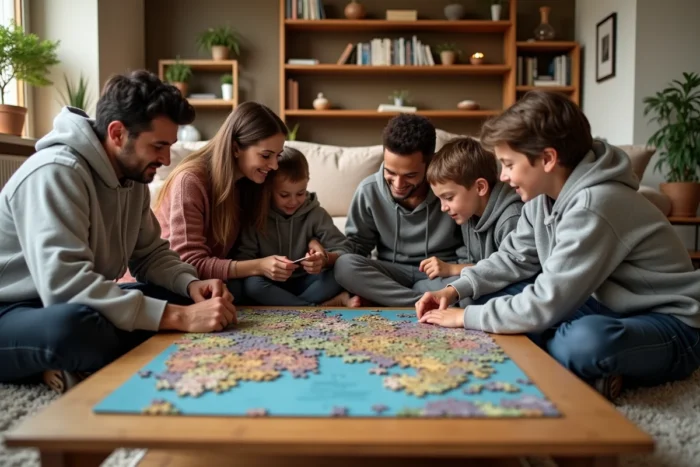
Cooperative games are not just for keeping children occupied. We see them as a tool for restoring the atmosphere between siblings after a conflict. The collaborative fort, the obstacle course designed together, or fun tidying missions require players to negotiate, assign roles, and accept a collective outcome.

The role-reversal game after a dispute deserves special attention. Each child reenacts the scene by taking on the role of the other. This approach, recommended by several recent parenting guides, defuses tension much faster than a frontal discussion. It works as soon as children master the basics of language, around four or five years old.
Intergenerational board games complement this approach. When grandparents and grandchildren share a game, the rules impose a common framework that transcends age gaps. The effect on mutual understanding between generations far exceeds mere entertainment.
Criteria for choosing a suitable cooperative game
- The game must offer a clear common goal, with no individual winner, in order to eliminate rivalry between players
- The duration of the game should not exceed the attention span of the youngest participant, lest the moment turn into a source of frustration
- The number of players must match the actual number of members present, with no passive role for any participant
Remote activities for geographically dispersed families
Maintaining family ties from a distance is now possible without losing relational quality. Synchronized cooking sessions via video, where each household prepares the same dish in real-time, generate a sense of closeness that we find comparable to a shared meal in person.
Online cooperative games, adapted for intergenerational versions, allow grandparents to participate from their homes. Feedback on these practices is very positive: participants describe a feeling of connection despite physical distance. These shared moments create common memories, even without being in the same room.
The key lies in regularity. A weekly twenty-minute video session with a specific goal (sharing a childhood memory, showing a drawing, reading a passage from a book together) has more impact than a monthly call without structure.
Structuring family time: duration, location, and relational objective
We observe a recurring mistake: planning entire days of activities without defining a relational objective. Wanting to “have a good time” remains too vague. Naming the intention changes the quality of the exchange. A picnic with the stated goal of “everyone sharing their best moment of the week” produces richer interactions than a park outing without a framework.
Structuring does not mean rigidity. It involves calibrating three parameters:
- The duration, adapted to the youngest participant to avoid fatigue and frustration at the end of the day
- The location, chosen based on the activity and not the other way around, to avoid compromises that satisfy no one
- The explicit relational objective, shared aloud with all members before starting
Intergenerational transmission through everyday activities
Weekly meals, sharing family memories, caring for the garden, or small trips shared across generations are not just simple activities. They are the main vector for transmitting family traditions. When a grandparent shows a child how to prune a shrub or prepare a family dish, they pass on a know-how rooted in a shared history.
This type of activity requires neither budget nor special materials. It only asks for intention and a time-space protected from screens. The child’s development gains in identity markers, and the intergenerational relationship deepens without artificial effort.
Families that integrate these moments into their weekly routine find that regularity matters more than the duration or originality of the chosen activity. A quarter-hour of shared gardening every Saturday morning establishes a stronger ritual than an exceptional outing twice a year.