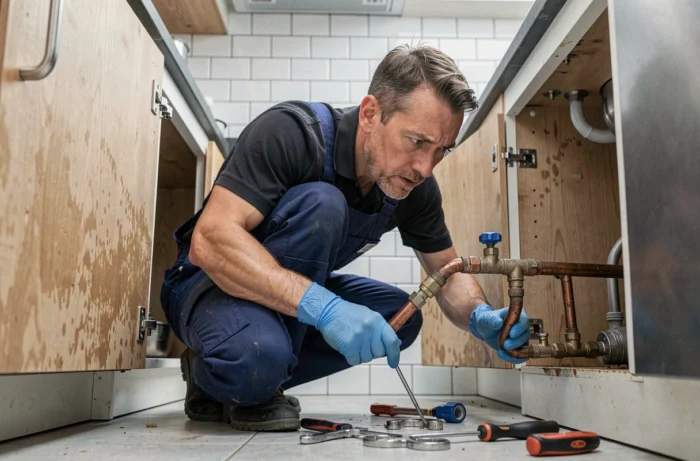
In the Brussels real estate market, a significant portion of plumbing interventions stems from predictable defects related to the aging of networks or repeated user errors. Identifying the technical causes allows for action before the bill escalates.
Aging of riser pipes and material compatibility in apartments
Brussels buildings from before the war often retain riser pipes made of lead or galvanized steel. These pipes, sometimes over a century old, present a double problem: internal corrosion that reduces the usable diameter and galvanic incompatibility with copper fittings installed during partial renovations.
When a co-owner replaces their apartment’s copper plumbing without a dielectric sleeve at the junction with the steel riser, corrosion accelerates at the contact point. We regularly observe perforations within just a few years on these poorly protected fittings.
Before any bathroom renovation, we recommend a diagnosis of the riser pipe material. If it is galvanized steel, installing an insulating fitting or switching to multilayer with appropriate transition prevents premature degradation of the common network. This point is rarely addressed by articles discussing common plumbing issues in Brussels, even though it constitutes a major source of claims in co-ownership.
Water pressure and pressure reducer in upper floors
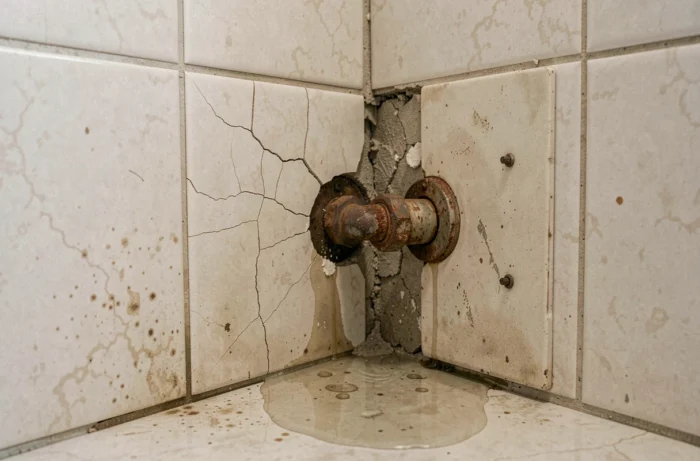
The distribution pressure in Brussels varies by municipality and the building’s altitude. In multi-story buildings without a booster pump, upper floor apartments experience low tap flow. Conversely, ground floors sometimes receive excessive pressure that stresses joints, washing machine hoses, and shut-off valves.
A pressure reducer set between 3 and 4 bars at the apartment’s entrance protects the entire plumbing system. Without this equipment, water hammer can fatigue the welds and cause micro-leaks behind walls, detected late.
Also check the condition of the supply hose under the sink and behind the washing machine. These stainless steel braided hoses have a limited lifespan. Preventive replacement every five to eight years eliminates a frequent risk of water damage in apartments.
Connected leak detection: cutting off water before a disaster
Connected leak detectors change the game for residents who are absent during the day. According to an article published by Immovlan in September 2026, a low-cost detector paired with a smart valve can automatically cut off the water in case of a detected leak on the floor.
This type of device is placed near the water heater, under the kitchen sink, or behind the dishwasher. The motorized valve is installed on the apartment’s main supply. In case of an alert, the supply is cut off within seconds, even if no one is present.
For a Brussels apartment, this approach is particularly relevant:
- Water damage in co-ownership engages the responsibility of the owner of the unit from which the leak originates, which can represent a heavy cost in repairs for the neighbors below.
- Water scarcity in Brussels, more pronounced than in Flanders or Wallonia according to RTBF data from 2024, makes every liter wasted by an invisible leak even more problematic.
- Home insurance companies are beginning to value automatic shut-off systems, which can influence coverage conditions.
Blocked pipes: limescale and drainage errors in the kitchen
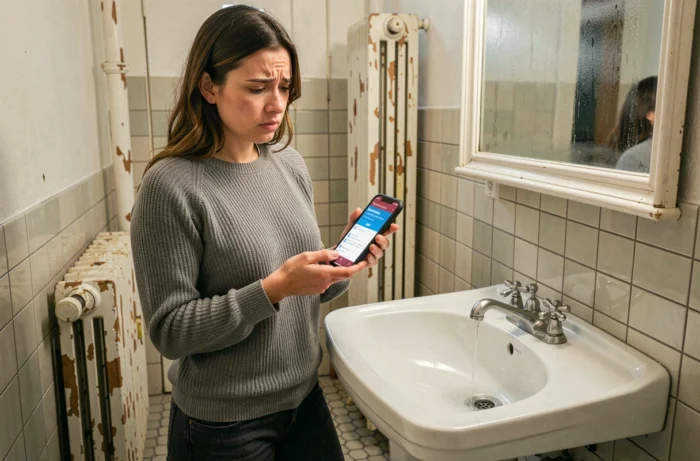
The water distributed in Brussels is moderately to highly calcareous depending on the neighborhoods. Limescale deposits in bends, traps, and diameter reductions gradually decrease the drainage section. Combined with residues of solidified grease, it forms a hard blockage that commercial chemical products do not dissolve.
Mechanical cleaning of the trap remains the most reliable method to maintain proper drainage. A quarterly disassembly of the trap under the kitchen sink, with manual removal of deposits, prevents the majority of blockages.
In the bathroom, hair is the primary factor for blockages. A fine mesh placed over the shower drain reduces the problem, provided it is cleaned after each use. For hard-to-access built-in drains, a small diameter manual auger is sufficient in most cases before calling in a professional.
Energy performance compliance and plumbing: an underestimated intersection in Brussels
The gradual tightening of energy performance requirements in Brussels, with thresholds narrowing until 2033, directly concerns plumbing and heating installations. Replacing a boiler, insulating hot water pipes, or installing thermostatic faucets counts towards the energy certificate calculation.
In an apartment, insulating uninsulated hot water pipes represents a measurable energy performance gain for a modest investment. Visible pipes in the basement or technical shafts lose a significant amount of heat if their insulation is absent or degraded.
Coordinating plumbing renovation with energy improvement avoids having to reopen walls or floors a few years later. When replacing a boiler, we systematically recommend checking the diameter and condition of sanitary pipes to anticipate future work.
The obligations that apply to Brussels landlords reinforce this logic: a rental property must meet health criteria that include the proper functioning of sanitary appliances and the absence of leaks. A failing network can block rental opportunities just as much as a poor energy performance score.
Anticipating these points during a bathroom or kitchen renovation, rather than addressing each problem in isolation, remains the most effective strategy for a Brussels apartment whose installations are approaching or exceeding thirty years old.