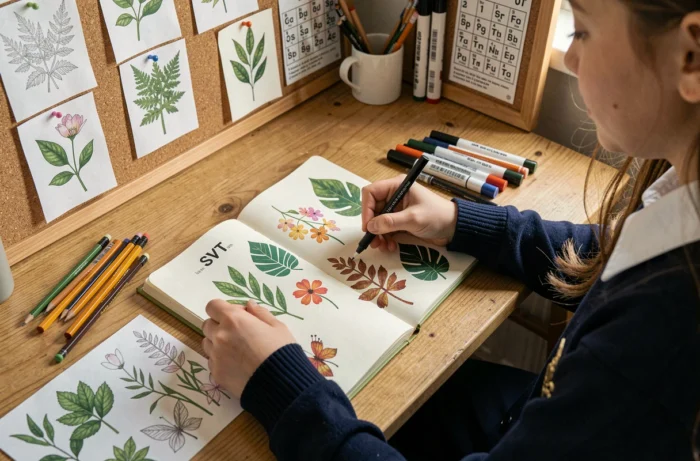
When you open a life sciences notebook in September, the first page sets the tone for the rest of the year. A well-designed cover page, with illustrations related to life and earth sciences, transforms a simple notebook into a resource that the student is eager to open. However, it is essential to find models suitable for the right format, the right level, and to print them correctly without spending an hour fiddling with software.
A4 format and paper weight: what determines the result
Before choosing a model, check the format of the notebook. In middle school, the small 17×22 cm notebook has almost disappeared in 9th grade. The trend is towards A4 format (21×29.7 cm) for notebooks, binders, and display books, and most of the available life sciences cover pages online are designed for this standard.
The weight of the paper is just as important as the visual aspect. A sheet that is too thin (80 g/m²) allows the ink from the next page to show through, especially if the student colors with markers. It is preferable to use a sufficiently dense weight so that the colors remain sharp without bleeding through. Standard printer paper is suitable for light pencil coloring but not for solid marker applications.
On the printer side, the “draft quality” mode washes out the illustrations. It is better to switch to normal or photo quality, even if it means using a bit more ink. For those who want to download from Mister Papa ready-to-use models, the PDF file launches directly from the browser without additional software.
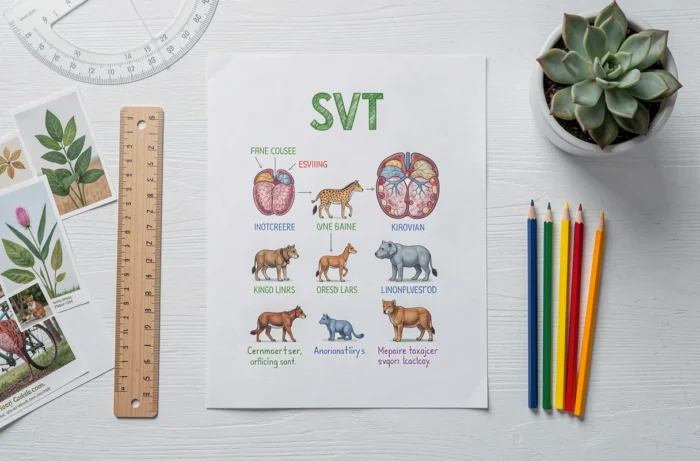
Life sciences cover page by level: 6th grade unified sciences, 5th grade separate subjects
A classic trap at the start of the school year: preparing a “life sciences” cover page for a 6th grader when the subject no longer exists as such at this level. Since the last reform of middle school, life sciences have been merged with physics-chemistry and technology under the title “Sciences and Technology” in 6th grade. Most 6th graders only have one science notebook.
The distinction changes starting in 5th grade. The single block splits into three distinct subjects, each with its own teacher and its own notebook. Families must then prepare three different cover pages for sciences instead of just one. This is when models specifically labeled “life sciences” make perfect sense.
Adapting the visual to the curriculum
In 5th grade, the life sciences curriculum covers the nutrition of organisms and external geology. In 4th grade, it shifts to reproduction and natural risks. In 3rd grade, genetics and immunology dominate. Choosing an illustration consistent with the curriculum of the level yields a more personal result than a generic microscope drawing.
- For 5th grade: illustrations of plants, rocks, or food chains correspond well to the chapters studied
- For 4th grade: simplified diagrams of cells, volcanoes, or tectonic plates reflect the course content
- For 3rd grade: representations of DNA, immune systems, or planet Earth align with the end-of-cycle curriculum

Coloring or printing in color: two approaches depending on available time
There are two types of life sciences cover pages to print. Coloring models, printed in black and white, allow the student to personalize their cover. Fully colored models come ready to stick.
Coloring pages work better for 5th and 6th graders, who still enjoy this type of activity at the beginning of the year. Coloring also allows for adapting colors to the code adopted by the teacher (some require a color per subject for the binder).
Pre-colored models are more suitable for 4th and 3rd graders, who are often rushed or less inclined to spend time on decoration. They are printed in photo quality, cut neatly, and done in five minutes. Feedback varies on this point: some 3rd graders still love to personalize, while others just want a clean result without effort.
What to write on the cover page
A downloaded model generally has areas to fill in. The minimum information is simple but often forgotten in the rush of the start of the school year:
- Student’s first and last name, written legibly (the teacher should be able to identify the notebook at a glance)
- Class and school year, to avoid confusion with the previous year’s notebook
- Subject name as the teacher uses it: “life sciences,” “Sciences de la Vie et de la Terre,” or “Sciences and technology” in 6th grade
- Teacher’s name, required by some institutions to facilitate sorting in case of a lost notebook
Popular life sciences themes for cover pages and image choices
Template banks offer dozens of visuals, but a few themes consistently recur because they represent the discipline well. Illustrations combining plants, animals, and geological elements remain the most versatile: they cover the three pillars of life sciences without being limited to a single chapter.
Naturalist-style motifs (leaves, insects, rock cuts) provide a polished look without overcrowding the page. In contrast, overly dense photographic montages lose readability once printed, especially on an entry-level inkjet printer.
For a life sciences notebook that lasts all year without curling, glue the cover page with stick glue applied over the entire surface, not just the corners. A few minutes under a heavy book prevents bubbles and wrinkles. This detail makes the difference between a cover that peels off in October and one that stays neat until June.
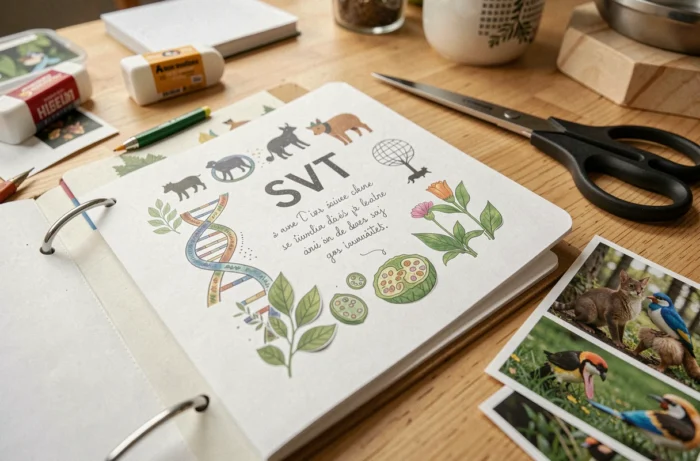
Choosing a life sciences cover page suitable for the level, the format of the notebook, and the student’s taste takes barely a quarter of an hour. It’s a minimal investment for a notebook that the child will handle hundreds of times throughout the year, and the first impression on a teacher collecting notebooks is never trivial.