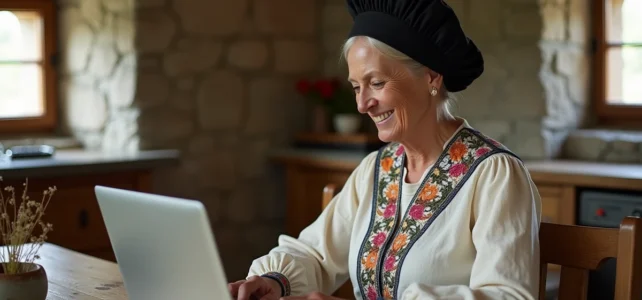
Breton culture encompasses a set of linguistic, musical, festive, and heritage practices rooted in the five historical departments of the Armorican peninsula. Accessing these resources from a screen requires platforms capable of structuring dense content, often scattered among local associations, municipal archives, and individual initiatives. Several digital tools are currently attempting to unify this material to make it readable from a distance.
Online courses and degree programs on Breton culture
The MOOC (Massive Open Online Course) format applied to regional culture is still uncommon in France. The platform Mook.bzh stands out as an exception: it offers popularization courses covering the history, geography, dance, languages, traditional clothing, and economy of Brittany across its five departments.
What distinguishes this type of tool is the dual entry. A curious visitor can explore the modules freely, without commitment. A more invested learner can follow a structured training program, supported by speakers from the academic and associative worlds, culminating in a degree pathway.
The program relies on resource individuals specialized in their field. This logic of co-construction between experts and the digital platform gives the content a density that simple tourist compilations do not reach. To discover Culture Bretagne online, other portals aggregate the cultural news of the region from an editorial perspective, complementing these educational pathways.
Breton language: free digital learning tools
The transmission of the Breton language now takes place through digital channels accessible without prerequisites. The Desketa platform allows for free learning of Breton, and its use is promoted even in high schools through materials created by youth from the Regional Youth Council.
These materials take various forms:
- Bilingual posters (French-Breton) with QR codes linking to playlists of Breton music, documentary resources, and regional tales.
- A board game titled “Voyage en Bretagne,” designed on the principle of Trivial Pursuit, questioning the cultural specifics of the region.
- A werewolf game adapted into Breton, with characters directly inspired by local myths and legends.
This gamification work led by the culture and languages commission of the CRJ Bretagne in 2026 illustrates a fundamental trend: young Bretons do not just receive culture, they reformulate it in formats that resonate with them. The transition from oral heritage to bilingual board games is not trivial; it changes the relationship to the language.
Traveling festivals and cultural hybridization in Brittany
Living Breton culture is not limited to traditional Celtic circles. In 2026, the Kenleur Tour will travel through the five Breton departments from July 4 to August 23, with a program centered around dance, music, and Celtic circles. This traveling format aims to reach audiences far from major cultural centers like Rennes or Quimper.
At the same time, hybrid formats are emerging. In Spézet, a weekend dedicated to Breton dance integrated a Grand Bal Breton Brésilien at L’Estran, blending Breton repertoire with Brazilian influences. This type of crossover is not cosmetic: it attracts an audience that would not have crossed the threshold of a classic fest-noz.
The hybridization of Breton festive practices broadens the audience without diluting the repertoire. Musicians play on Breton rhythmic structures (an dro, gavotte) while incorporating percussion or harmonies from elsewhere. The foundation remains identifiable, but the sound envelope changes.
Workshops in schools: the local relay
In Cavan, the Ti ar Vro Treger-Gouelou school organizes regular cultural workshops in Breton, with strong involvement from local associations. France 3 Bretagne describes it as the beating heart of Breton culture and language in Trégor.
This network between associative structures, schools, and digital platforms creates an ecosystem where each entry point refers to the others. A student who discovers a tale in Breton via a QR code in class can then delve deeper on Desketa, and later attend a fest-noz of the Kenleur Tour during the summer.

Breton heritage online: beyond the virtual visit
Several digital initiatives allow exploration of the built and landscape heritage of Brittany without traveling. Breton exhibitions listed on cultural agendas cover themes ranging from contemporary art to archaeology, including maritime history.
The challenge for these platforms is not to replace the physical visit to a castle or a megalithic site. It is to provide a framework for prior understanding. Understanding the historical context of a place before visiting transforms the experience into a documented one rather than a simple stroll.
The portals of Breton cultural news play a role as a crossroads: they aggregate information on ongoing projects, temporary exhibitions, and upcoming events. This editorial work of connecting physical heritage with its online documentation remains the most useful link for a non-specialist audience.
Today, Breton culture has a more structured digital network than a few years ago, encompassing thematic MOOCs, language learning platforms, and federating cultural agendas. The challenge that remains to be met concerns less the production of content than its readability: finding the right pathway among dozens of scattered resources still requires an effort that few portals truly simplify.