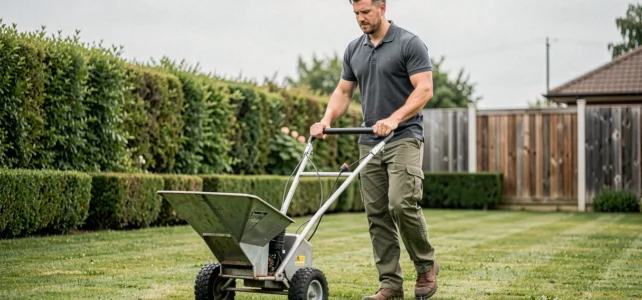
A lawn overrun with clover or plantain is not treated the same way as a lawn that is simply tired from the summer. Selective treatment targets broadleaf weeds (dicotyledons) without affecting grasses, but its effectiveness depends less on the product chosen than on the conditions under which it is applied. Temperature, soil moisture, growth stage of the weeds: these parameters determine the outcome long before the brand on the bottle.
Active growth of the lawn: the criterion that the weather does not summarize
We often talk about a “good time” to treat, citing spring or autumn. This is an oversimplification. What really matters is that the lawn and the weeds are in a phase of active growth. A grass in summer dormancy or a dandelion at the end of its cycle poorly absorbs the product, and the result will be mediocre.
In practice, we check three things before taking out the sprayer. Is the grass visibly growing between two mowings? Do the weeds have well-developed leaves, neither wilted nor yellowing? Is the soil moist deep down, not just on the surface after a quick shower?
If any of these conditions are lacking, we postpone. A treatment applied to a lawn stressed by drought risks burning the grasses as much as the weeds, which negates the whole point of selectivity. To apply a selective treatment to the lawn with a clear result, we wait for the lawn to be in good shape, not just for the calendar to say April or September.
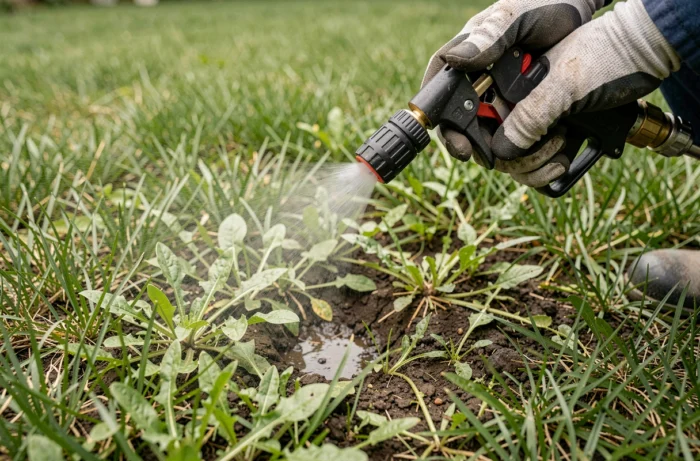
Ideal weather window for effective selective lawn treatment
The product works by foliar absorption: the leaves of dicotyledons capture the active substance, which then circulates through the plant to the roots. This systemic mechanism works provided that the stomata of the leaves are open, which requires weather that is neither too hot nor too windy.
Conditions we aim for
- Moderate temperature, ideally below the threshold of high heat. Spraying during a heatwave causes leaf burn on the lawn itself, even with a well-dosed selective product.
- Low to no wind. Spray drift sends the product onto neighboring flower beds, hedges, or the vegetable garden. Early in the morning, before the wind picks up, remains the safest time slot.
- No rain expected in the hours following. The product needs to stay on the foliage to be absorbed. A shower two hours after application rinses it off before it has acted.
- Soil not dried out. A dry surface soil prevents the plant from being in normal metabolic activity, reducing the effectiveness of the treatment.
Feedback varies on the exact delay without rain needed, with some products claiming faster resistance to leaching than others. We rely on the manufacturer’s instructions, keeping in mind that an extra safety margin costs nothing.
Preparing the ground before selective spraying
We do not spray a selective herbicide on a lawn mowed the day before. Mowing cuts the leaves of the weeds, reducing the absorption surface. Allowing the weeds to develop their foliage before treating significantly increases the amount of product captured by each plant.
In practice, we mow three to five days before treatment, then allow the weeds to regrow a bit. After application, we wait several days before the next mowing to let the product circulate in the plant.
The trap of “weed and feed”
Combined fertilizer + herbicide products (weed and feed) are tempting because they promise two results in one pass. Recent specialized guides increasingly present them as a special case, not a universal solution. They are only suitable when the lawn is already in good overall condition and the infestation remains moderate.
On a sparse or heavily infested lawn, separating fertilization from weeding provides better control over each operation. We fertilize first to strengthen the grasses, then treat the weeds once the lawn has regained vigor. The opposite (treating a weakened lawn) exposes one to disappointing results.
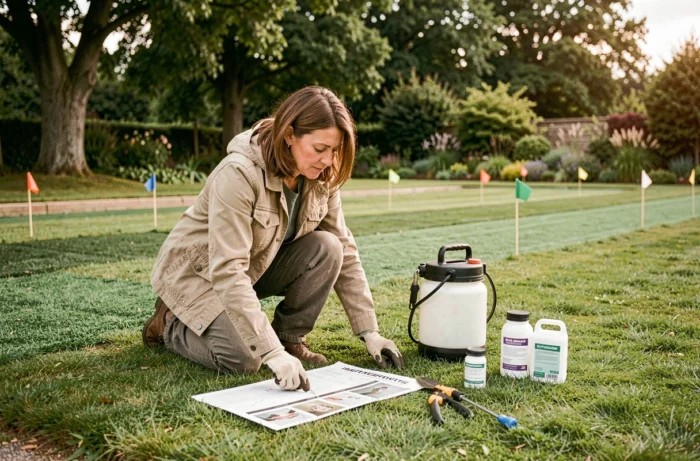
Regulation of selective weeding in France and Belgium
Since the Labbé law of 2019, individuals in France no longer have access to synthetic herbicides for gardens. Classic selective products based on 2,4-D or dicamba remain reserved for professionals with a Certiphyto. For a French amateur gardener, selective treatment now involves biocontrol products or solutions based on pelargonic acid, which are less selective by nature.
In Belgium, regulations differ by region. Wallonia and Flanders each have their own restrictions, but some selective herbicides remain accessible to individuals under certain conditions. We systematically check the product’s authorization status on the phytoweb.be portal before purchase.
This regulatory distinction changes the game on the ground. A French individual who wants a professional result will often have to combine mechanical methods (targeted pulling, scarification) with an authorized product, whereas a professional can still use a systemic selective herbicide.
Dosage and spraying technique for a uniform result
Under-dosing is the primary cause of failure. We think we are doing well by reducing the amount of product, but the weeds partially survive and regrow more resistant. The dosage prescribed by the manufacturer is a minimum, not a maximum to be divided.
For spraying, a pre-pressurized device with a flat jet nozzle provides the best consistency. We move at a steady pace, in parallel strips, without going over the same spot twice. A double pass creates localized overdosing that yellows the lawn.
The conical jet nozzle, often supplied by default, projects fine droplets that are more sensitive to wind. On a medium-sized lawn, investing in a flat slot nozzle radically changes the uniformity of the result.
Selective lawn treatment ultimately relies on a simple logic: observe before acting. The state of the lawn, the weather of the day, and adherence to the dosage weigh more heavily than the choice of brand. An average product applied under the right conditions consistently outperforms a high-end product sprayed at the wrong time.