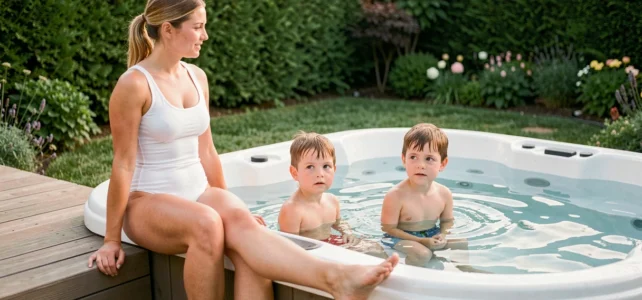
A child under five years old should not be in a hot tub. The position of the American Academy of Pediatrics (AAP) and the CDC leaves no room for interpretation on this point. We will detail the physiological mechanisms that underlie this limit, the technical parameters to master beyond this age, and the points of vigilance that most consumer guides overlook.
Infant Thermoregulation and Physiological Constraints of the Spa
The thermoregulatory system of a young child fundamentally differs from that of an adult. The body surface area relative to weight is proportionally larger, which accelerates thermal exchanges with the surrounding water. The result: a significantly faster rise in internal temperature in a hot bath.
In a three or four-year-old child, the mechanisms of sweating and peripheral vasodilation are still immature. The body struggles to dissipate excess heat, which exposes them to hyperthermia in just a few minutes in water at 37-38 °C, a temperature that is standard for an adult.
We recommend considering this physiological threshold as non-negotiable. An inflatable hot tub set to the same temperature as a rigid spa presents exactly the same risk: it is the combination of hot water and immature thermoregulation that is problematic, not the type of tub.
The question of at what age a child can go in a hot tub deserves an answer articulated around medical data, not just parental feelings.
Water Temperature and Bath Duration: Technical Thresholds to Respect
For children under five, the use of a hot tub is not recommended by the AAP and the CDC, regardless of the temperature or duration considered. Beyond this age, access becomes feasible under strict conditions.
Maximum Temperature for a Child
The technical guideline is not to exceed 30 to 32 °C for a child aged five to seven years. This level is well below the usual setting of an adult spa. On most home spas, this means adjusting the thermostat several hours before bathing and checking the actual temperature with an independent thermometer, as the built-in sensor may have a discrepancy of one to two degrees.
From the age of eight, some sources allow water at 34-35 °C, but caution remains advisable. A child does not always report a sensation of thermal discomfort as quickly as an adult.
Session Duration
The recommended duration for a child is between five and ten minutes per session. This timeframe may seem short, but it reflects the speed at which body temperature can rise in a hot tub. Enforcing a break out of the water of at least fifteen minutes before a possible second immersion allows the body to regain its thermal balance.
- Five to six years: water at 30-32 °C, maximum five minutes, constant supervision within arm’s reach
- Seven to nine years: water at 32-34 °C, maximum ten minutes, adult present in the tub or at the immediate edge
- Ten years and older: water up to 35 °C, maximum fifteen minutes, regular reminders to hydrate
Specific Risks Related to Jets and Suction
Hyperthermia draws attention, but it is not the only danger. Suction systems and massage jets create mechanical risks that are rarely detailed in family guides.
A child with long hair that is not tied up can have their hair sucked into the main drain or a skimmer opening. Cases of immobilization underwater related to this phenomenon have been documented, including in home spas. The suction power of a filtration pump, even a modest one, is enough to hold a struggling child.
Anti-suction grates that comply with standards must be checked before each use. A cracked, poorly secured, or missing grate turns a relaxation session into a risky situation. On an inflatable spa, the simplified design of the filtration systems reduces this danger but does not eliminate it entirely.
High-pressure massage jets are another point of vigilance. A child’s skin is thinner, and prolonged exposure to a jet directed at the same area can cause skin irritation or even superficial bruising. We recommend disabling the strongest jets or setting the intensity to minimum during bathing with children.
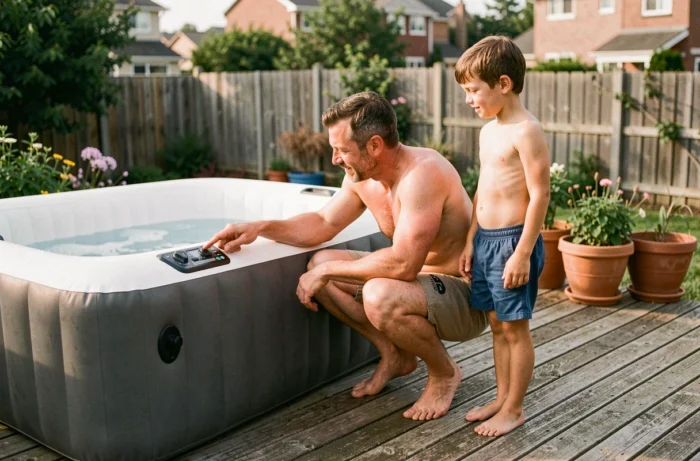
Water Treatment and Children’s Skin Sensitivity
A hot tub maintained at high temperature creates a favorable environment for bacterial growth. The chemical treatment of the water (bromine, chlorine, active oxygen) must be adjusted and monitored more frequently when children use the tub.
The skin of a child aged five to eight years has a slightly different skin pH than that of an adult and a thinner dermal layer. Overdosed disinfectant water can cause quicker reactions: redness, itching, irritation of the eyes and mucous membranes.
- Test the disinfectant level with strips before each child bath
- Rinse the child with clear water immediately after leaving the hot tub
- Avoid immersion if shock treatment has been performed in the last few hours
- Monitor any skin reactions in the hours following the bath
A spa whose water is not analyzed on the same day should not accommodate a child. Parameters change rapidly in a small volume of hot water, especially after use by several adults.
Securing the Spa When Not in Use
The majority of accidents involving children and spas occur outside of supervised bathing times. An accessible spa in a garden, on a terrace, or in a dedicated room poses a permanent danger if access is not physically blocked.
A lockable rigid cover remains the most reliable solution. Soft covers placed without fastening cannot withstand the weight of a child climbing on them, creating a risk of falling into the water combined with a risk of immobilization under the cover.
For inflatable spas, the temptation to leave them filled and accessible is strong during the summer. Draining the tub or installing a physical barrier remains the only effective prevention against unsupervised access.
The AAP and CDC’s rule of a minimum age of five does not exempt the application of these passive security measures at all ages. An eight-year-old child left alone in front of an open spa remains exposed to the risk of drowning, especially since the seating depth of a spa can be enough to immerse a small child.