The Community of Communes of the Rhine (CC Rhin) brings together several Alsatian municipalities along the river, with intercommunal responsibilities that encompass both land use planning and services for residents. Following its news allows for an understanding of the decisions that affect local life, infrastructure projects, and community events.
Responsibilities and Scope of CC Rhin in Alsace
The communities of communes located along the Rhine in Alsace share a set of responsibilities defined by the general code of local authorities. Their scope of action goes beyond mere administrative management.
To find CC Rhin’s information on ongoing projects and recent deliberations, the official website centralizes publications by theme. This facilitates the tracking of intercommunal decisions without having to sift through reports municipality by municipality.
The areas covered vary from one intercommunity to another, but several key themes consistently emerge:
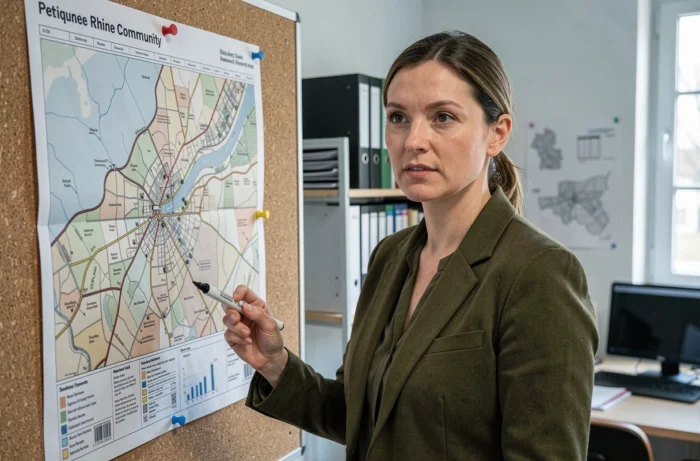
- Spatial planning and urban planning, particularly with intercommunal local urban plans (PLUi) that regulate the buildability of land
- Waste management and selective collection, often pooled to reduce costs per resident
- Economic development, which includes the management of business zones and support for local businesses
- Social action and early childhood, with structures such as parent-child welcoming places or childminder networks
Navigation on the Rhine: Regulatory Framework and River Transport Issues
The Rhine remains one of the busiest inland waterways in the world. Daily traffic varies by section: about 600 boats per day at the German-Dutch border, compared to around a hundred at Iffezheim, further upstream. The volumes transported reach around 200 million tons at the German-Dutch border.
The active fleet on the Rhine is estimated at around 6,900 boats representing 10 million tons of deadweight, including 4,400 push boats, 1,300 tankers, and 1,200 barges. These figures place the Rhine corridor at the center of logistical exchanges between France, Germany, Switzerland, and the Netherlands.
The Role of the CCNR in River Regulation
The Central Commission for the Navigation of the Rhine (CCNR), established under the Mannheim Act, sets legally binding rules for all member states bordering the river. Its framework covers the technical safety of boats, crew qualifications, and environmental standards.
Hester Duursema has held the position of Secretary General since January 2026, marking a change in administrative coordination. This type of transition can influence institutional priorities, particularly regarding the decarbonization of river transport and the harmonization of safety standards.
| Section of the Rhine | Average Daily Traffic (boats/day) |
|---|---|
| Germany/Netherlands Border | 600 |
| Cologne | 400 |
| Mayence | 300 |
| Karlsruhe | 200 |
| Iffezheim | 100 |
Low Water Levels on the Rhine: An Operational Risk Without Automatic Thresholds
Episodes of low water on the Rhine are a recurring issue for river transport operators, riverside municipalities, and industries dependent on the waterway. The CCNR reminds us of a technical point often misunderstood: there is no single low level that automatically triggers the closure of navigation.
The assessment of navigability depends on the section concerned, the vessel’s draft, and the type of cargo. A push boat loaded with hydrocarbons does not have the same constraints as a half-loaded container barge. River cruise companies are also affected, with modified or interrupted routes during pronounced low water conditions.
Consequences for the Municipalities of CC Rhin
For the communities located along the river, low water levels affect local port activity and revenues related to the transit of goods. Rhine ports, including Strasbourg, see their attractiveness fluctuate based on hydrological conditions.
Logistical surcharges may be applied by carriers when the available draft decreases. Shipowners then reduce the loading per vessel, which increases the unit cost per ton transported. This mechanism impacts the prices of goods transported by river.
Local Life and Intercommunal Events in the Alsatian Rhine
The intercommunalities of the Alsatian Rhine regularly publish activity programs for residents. These events cover a variety of themes: housing and leisure fairs, themed evenings for young parents, robotics clubs for schoolchildren, or blood donation days.
The intercommunal magazines, distributed in both paper and digital formats, serve as a complementary communication channel. They detail the projects voted on in the community council, ongoing infrastructure works, and changes to local public services (waste collection hours, collection calendars, administrative offices).
Tracking the deliberations of the community council remains the most reliable way to know the budgetary orientations and planned investments. These reports are accessible online, usually within weeks following each session.
The news from CC Rhin touches on areas as concrete as water management, river transport, or local cultural programming. Regularly consulting the official publications of the intercommunity remains the best reflex to anticipate changes that affect the daily lives of residents and professionals in the sector.