
The registered letter R2 refers to a postal delivery that is handed over against a signature with an intermediate compensation level, set flat at €153 in case of loss or damage. It is positioned between R1 (minimum coverage) and R3 (maximum coverage), making it the most commonly used option for contractual documents and moderate values.
Compensation R2: what the €153 flat rate actually covers
The R2 recommendation rate is not insurance in the traditional sense. It is a capped compensation flat rate that La Poste pays if the mail is lost or damaged during transit. The amount of €153 does not depend on the actual value of the contents: whether the envelope contains a check for €80 or a document whose loss causes greater harm, the compensation remains the same.
This distinction has a direct consequence on the choice of rate. R2 is suitable when the contents have a moderate value or when proof of sending takes precedence over financial coverage. To know precisely what a registered letter R2 is and in which cases it is necessary compared to other levels, one must think in terms of actual risk, not administrative reflex.
In practice, R2 is recommended for sending small amounts of cash, payment methods (checks, securities), or contractual documents whose reconstruction would be costly but not impossible. R1 is sufficient for a simple letter of formal notice where only proof of deposit matters. R3 is justified for items of significantly higher value.

Proof of deposit and acknowledgment of receipt: the legal value of the registered R2
The level of recommendation (R1, R2, or R3) does not change the legal value of proof of sending. A registered R1 has exactly the same evidential effect as an R2 in court. The difference lies solely in the amount of compensation in the event of postal loss.
Every registered letter, regardless of its rate, generates two elements of proof:
- The proof of deposit, given to the sender at the time of sending, which certifies the date and declared content of the mail.
- The acknowledgment of receipt (AR), returned to the sender after the recipient’s signature, which proves that the item was delivered to the correct person or their representative.
- The online tracking, accessible via an identification number, which traces each step of the delivery process until distribution.
The acknowledgment of receipt is optional. One can send a registered R2 without an AR, but in practice, nearly all legal mailings include it. It is the combination of registered + AR that makes the mailing enforceable in case of dispute, particularly for lease terminations, formal notices, or notifications mandated by law.
Filling out the registered R2 support: choosing the rate on the form
On the registered form (manual or online), the recommendation rate is selected by checking the corresponding box: R1, R2, or R3. If no box is checked, the R1 rate is applied by default. This rule often traps senders who think they are benefiting from intermediate coverage when they have checked nothing.
The new registered supports incorporate a Smart Data code (QR code) that facilitates automated processing at the post office. This code contains pre-filled information (addresses, chosen rate) and speeds up the counter process. For online shipments, the rate selection is made during the order, before printing the label.
R2 rate compared to R1 and R3
The additional cost between an R1 and an R2 remains modest for a standard shipment of less than 20g. The price difference reflects only the difference in coverage. Upgrading to R3 represents a more significant additional cost, justified only if the value of the contents greatly exceeds the R2 limit.
The pricing arbitration boils down to a simple question: does the content of the envelope exceed €153? If yes, R3 is necessary. If not, R2 offers the best balance between coverage and postage cost.
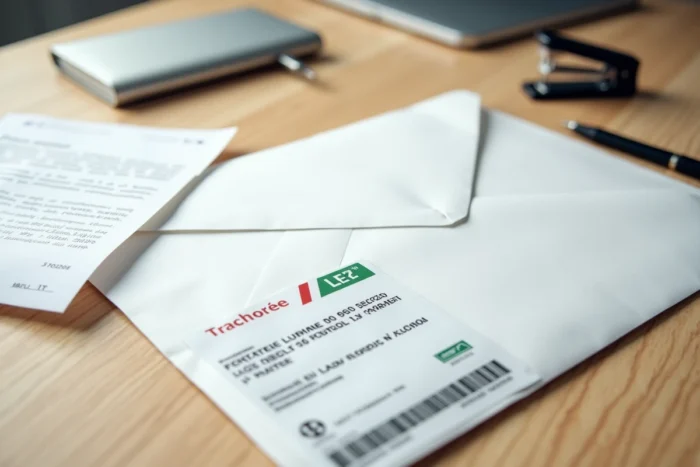
Registered R2 paper or electronic: two formats, same evidential value
The electronic registered letter (LRE) is gaining ground against the paper format. It produces the same legal value as a traditional postal registered letter, provided it is sent through a qualified provider. The R2 recommendation rate applies in the same way, with the same compensation ceiling.
The major difference lies in the delivery. A paper registered letter is handed over in person by the postman, against a physical signature. An electronic registered letter arrives in a secure online space, and the recipient must identify themselves to access it. The refusal or non-collection produces the same legal effects in both cases: the mail is deemed presented.
For businesses that send regular volumes of registered letters (reminders, terminations, legal notifications), the electronic format reduces processing costs and eliminates the need to go to the post office. The choice of the R2 rate remains relevant in this context, as the coverage pertains to the declared content, not the physical medium.
Concrete use cases for the R2 registered letter
Four thousand texts of laws and regulations require the use of registered mail in France. R2 covers the majority of common situations without unnecessary extra costs:
- Termination of an insurance contract or a rental lease, where proof of sending is sufficient but where a refund check may be included in the response.
- Sending notarial documents, private deeds, or contractual pieces whose loss would incur reconstruction costs.
- Transmission of payment methods (checks, promissory notes) whose value remains below the €153 ceiling.
- Formal notice accompanied by original supporting documents that are difficult to reproduce.
R2, however, has no interest for a simple complaint letter or a cover letter: a tracked shipment or an R1 serves the same function at a lower cost. Choosing the right rate means assessing what the loss of the content would cost, not the desired degree of formality.