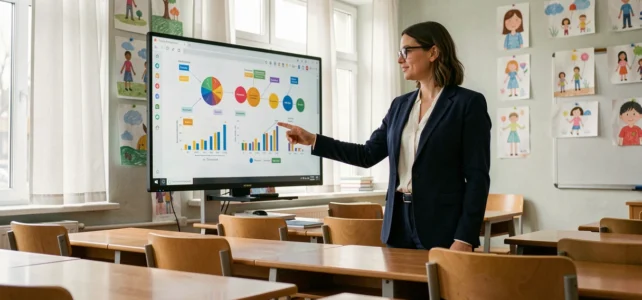
Each new school year brings its share of changes in schools, but recent educational news goes far beyond traditional curriculum adjustments. Since 2024, artificial intelligence has entered the classrooms, new European regulations are governing digital tools, and teachers are deeply rethinking their pedagogical practices. Understanding these developments allows parents, students, and education professionals to better support learning.
European Regulation on AI in the Classroom: What Changes Are Happening
You may have noticed that artificial intelligence tools are multiplying in the school environment. Automatic correctors, writing assistants, adaptive revision platforms: these technologies are now part of students’ daily lives.
The Regulation (EU) 2024/1689, better known as the AI Act, came into effect on August 1, 2024. Its most concrete provisions for educational institutions will apply from August 2, 2026. In practice, this means that every school using an AI system must comply with three specific requirements.
- Transparency of AI usage: students and their parents must know when an AI tool is used, in what context, and with what data.
- Digital literacy: institutions must train students and staff to understand the basic functioning of these systems, not just how to use them.
- Enhanced protection of student data, which is considered particularly sensitive under the regulation.
For teachers, this translates into new documentation obligations. Each AI tool deployed in class must undergo a prior evaluation. The educational resources published on echosdecole.fr allow for tracking these regulatory developments throughout the school year.
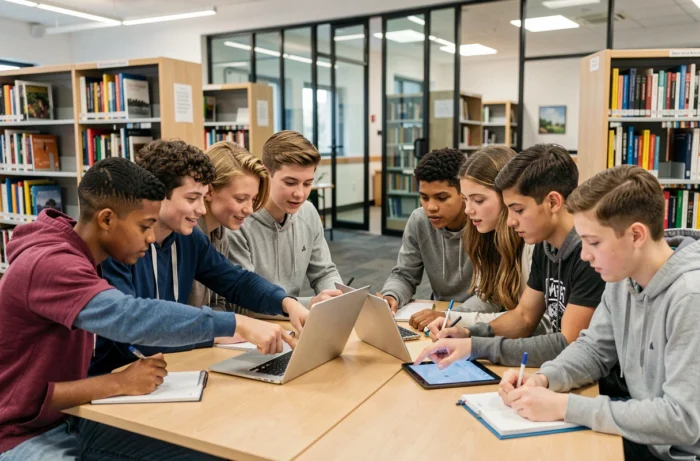
National Frameworks for AI in Schools: France and the United States Move Forward
European regulation is not the only one evolving. In the United States, the Federal Department of Education sent a framework letter to public schools in July 2025. This document specifies the legitimate uses of AI in education: creating educational materials, personalizing learning, and providing guidance support.
The French Position on Digital Education
The focus is on supporting the French edtech sector, which develops tools tailored to the national education system. These initiatives show that each country is building its own model of digital learning, with different priorities depending on cultural and institutional contexts.
Personalized Learning and the Role of Teachers: What AI Really Changes
Behind the regulatory announcements, the real question concerns what happens in the classroom. AI now allows for the provision of learning paths tailored to each student’s pace. A math exercise too easy? The platform adjusts the difficulty. A grammar concept poorly understood? The system offers a different explanation.
This does not replace the teacher. On the contrary, AI frees up time for individual support. When automatic correction takes care of repetitive exercises, the teacher can focus on explaining a complex reasoning or supporting a struggling student.
Limits to Keep in Mind
Why does this topic deserve caution? Because AI personalization relies on the collection of learning data. Every mistake, every hesitation, every response time feeds into a digital profile of the student.
Teachers must therefore master two new skills: evaluating the pedagogical reliability of an AI tool and explaining to students how their data is used. This is not a simple addition to the curriculum; it is a shift in professional posture for teachers.

Pedagogical Trends Beyond Digital in Schools
Educational news is not limited to artificial intelligence. Several underlying trends are transforming classroom practices, often in less visible but equally significant ways.
Interactivity as a driver of learning is gaining ground. Pure lectures are declining in favor of hybrid formats where students manipulate, debate, and produce. Educational resources are adapting: fewer static textbooks, more materials that teachers can modify according to their progress.
The design of school spaces is also evolving. Modular classrooms, with movable furniture, allow for a shift from group work to individual exercises in just a few minutes. This is not an aesthetic detail: the layout of the classroom directly influences communication between students and the quality of pedagogical exchanges.
The issue of languages is taking on an increasingly important role in curricula. Early bilingualism, long reserved for certain private institutions, is gradually spreading into public schools. Digital tools facilitate exposure to foreign languages from primary school, with applications that combine listening, repetition, and written comprehension.
Keeping up with educational news ultimately means observing an education system in full reconfiguration. Regulations set a framework, digital tools open up possibilities, but it is the teachers and students who, on a daily basis, invent the practices of tomorrow. The coming months will be crucial in measuring the real impact of the AI Act in European schools and the ability of institutions to train their teams to meet new requirements.