
Manga scans in French remain massively consulted in France, even in the face of a legal offer that has never been so extensive. The phenomenon goes beyond mere free access. Several mechanisms, both technical and cultural, explain why these unofficial platforms continue to attract a loyal audience in 2026.
ARCOM Blockages and the Streisand Effect on French Scans
Have you ever noticed that a closed scan site reappears under another name a few days later? This game of cat and mouse now structures the entire ecosystem.
Since 2024, ARCOM has been using court decisions allowing for dynamic blocking by internet service providers. In practical terms, ISPs can automatically block new mirrors of a site without having to go back to a judge with each domain change. More than 9,700 additional domain names were blocked in 2025, adding to the 19,000 already neutralized since 2022.
The result is paradoxical. Each closure generates articles, workaround tutorials, and discussions on social media. Platforms like Epsilonscan or Phenix Scans regularly change their addresses, reinforcing their image as “underground portals.” For part of the readership, accessing a scan becomes a community gesture, almost an identity reflex.
As detailed in the manga article on MaxiScoop, this dynamic of permanent migration fosters reader loyalty instead of discouraging them. Discord and Telegram communities share new addresses in real-time, creating a network effect that is difficult to break through purely judicial means.
French Manga Translation: Speed as a Decisive Argument
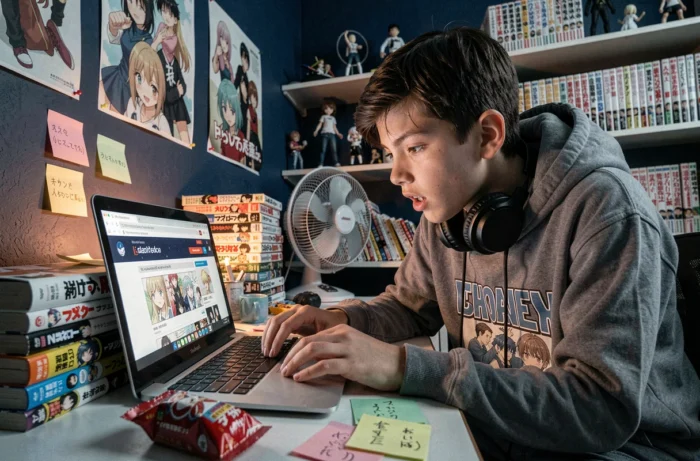
Time remains the crux of the matter. When a chapter is released in Japan, scanlation teams publish a French version within hours, sometimes less than a day.
Legal platforms have made progress. Manga Plus, for example, offers simultaneous chapters for certain titles in the Shueisha catalog. However, this simultaneity only covers a fraction of the available series. For the majority of mangas, the gap between the Japanese release and the official French version remains several weeks, or even several months.
This delay is significant for readers who follow series chapter by chapter. When your Twitter or Reddit feed is overflowing with spoilers as early as Friday morning, waiting for the official translation means excluding yourself from the conversation. VF scans fill this temporal void with a responsiveness that traditional publishing cannot yet match.
Quality of Amateur Translations in 2026
Francophone scanlation teams have professionalized. The most active groups have dedicated proofreaders, typographers, and image cleaners. The result is not always perfect, but it is often readable and coherent.
Some teams even adapt onomatopoeia and cultural references with more freedom than official publishers, which appeals to a readership accustomed to the codes of Japanese manga.
VF Manga Scan Catalog: Depth Unavailable Elsewhere
Why does a reader choose a scan site over a legal subscription? The answer often boils down to one word: the catalog.
Official platforms focus on the most popular or recent titles. A subscription to Mangas.io or a consultation on Manga Plus provides access to several hundred titles. Scan sites reference several thousand, including:
- Older or completed series that have never been published in French (mangas from the 1990s, niche seinen or josei titles)
- Korean manhwa and webtoons translated by Francophone teams, often absent from official French catalogs
- Bonus chapters, spin-offs, and one-shots that publishers do not systematically publish in their collected volumes
This depth of catalog attracts the most voracious readers, those who read multiple series in parallel and seek genres that are underrepresented in the French commercial offer.
Free Access and Digital Manga Reading Habits
Free access plays a role, but not in the way one might often imagine. The French paper manga market represented 309 million euros in 2024 with 36 million copies sold. Scan readers also buy paper mangas. Both practices coexist among a large part of the audience.
The scan functions as a discovery tool. A reader tests a series on a free site, then buys the physical volumes if they enjoy it. This behavior is documented by the publishers themselves, and some mangakas like Boichi (Sun-Ken Rock, Dr. Stone) have publicly nuanced the criticism of scanlation by acknowledging this leverage effect.
The Mobile Experience: An Underestimated Factor
Scan sites are optimized for reading on smartphones. Vertical scrolling, fast page loading, absence of DRM. This fluidity contrasts with some official apps where technical restrictions (inability to take screenshots, expiration of chapters after reading) create friction.
For a manga reader who checks chapters during commutes or breaks, the simplicity of access takes precedence over perceived legality.

VF Manga Scans and the Future of the French Market
French publishers like Glénat, Kana, or Ki-oon, along with Shueisha and Kodansha, have initiated coordinated legal actions against scanlation platforms such as Phenix Scans. This legal offensive marks a turning point in the strategy of rights holders.
The issue is no longer just about shutting down sites. It concerns the ability of the legal offer to replicate what makes scans strong: publication speed, catalog depth, mobile fluidity. As long as these three criteria are not aligned, VF scans will remain a major gateway to manga in France.
The French manga market, the second largest in the world after Japan, faces a productive paradox. Illicit consumption fuels the genre’s popularity, which in turn supports paper sales. Repression alone will not solve this equation. Only a legal digital offer that is as responsive and comprehensive as scans can sustainably shift reading habits.