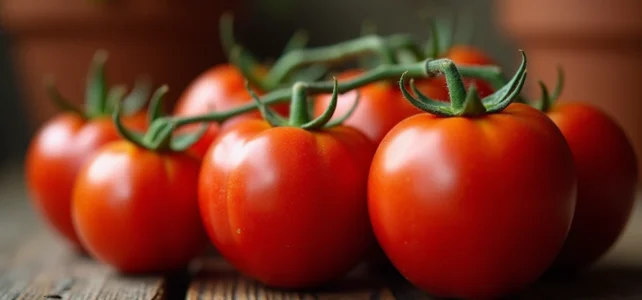
Biting into a garden tomato and hitting a tough skin is the kind of disappointment that drives one to seek concrete answers. This phenomenon affects both heirloom varieties and modern hybrids, and its causes go far beyond mere lack of watering. Several factors, including genetic, climatic, and cultural, interact to thicken the fruit’s cuticle. Understanding these mechanisms allows for action on the right levers in the vegetable garden.
Genetic selection and tomato skin: an industrial legacy in the garden
Gardening forums often point to watering or heat. They overlook a structural factor: the genetics of the seeds used. Since the 2000s, breeding programs have deliberately directed crosses towards thicker and stiffer skins. The objective is clear: to withstand mechanized harvesting, long-distance transport, and cold storage.
Joan Torras, a fruit and vegetable technician in Spain, explains that genetic crosses aimed at hard skin have been intensely practiced for productions in Andalusia and Murcia, then spread throughout the European fresh produce sectors. Anyone who collects seeds from supermarket tomatoes or chooses varieties labeled “long shelf life” or “crack-resistant” imports this genetic orientation, even under optimal growing conditions.
This point changes the perspective: before modifying watering or amending the soil, one must examine why tomatoes have thick skin by tracing back to their varietal origin. A Beefsteak or a Black Crimea, selected for taste and texture, will produce a significantly thinner skin than an F1 hybrid designed for commercial circuits.
Water stress and heatwaves: how climate thickens the cuticle
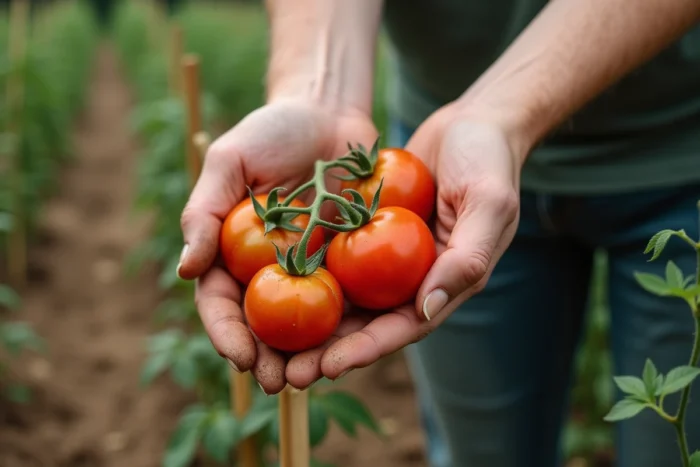
The tomato reacts to stress like an organism that protects itself. When the water supply becomes irregular, the fruit thickens its cuticle to limit evaporation. This is a survival mechanism, not a cultivation defect.
Irregular watering, the primary trigger
A soil that alternates between drought and saturation causes growth spurts. The skin, which has hardened during the dry phase, no longer keeps up with the rapid expansion of the fruit when water returns. The result: a thick skin that can also crack if the resumption of watering is too abrupt.
Feedback from gardeners converges on this point: heavy watering right after a heatwave is the action that causes the most damage. The skin has hardened to withstand the heat, then bursts under internal pressure when the fruit absorbs water within a few hours.
Recurring heatwaves and structural adaptation
Since the repeated heatwaves of 2022 and 2023, horticultural observations show a clear trend. Plants exposed to prolonged high temperatures produce fruits whose cuticle thickens structurally, even among varieties known for their thin skin. The phenomenon intensifies when nights remain warm, as the fruit does not benefit from the nighttime relaxation phase.
The available data do not allow for precise quantification of this thickening by region. Field reports vary on the exact extent of the phenomenon, but the correlation between heatwave episodes and tough skin is consistently documented.
Soil, calcium, and nutrition: deficiencies that harden the skin
Calcium plays a direct role in the cellular structure of the tomato. A calcium deficiency first weakens the internal tissues (causing apical necrosis, the infamous “blossom end rot”), but it also alters the texture of the skin. The plant, under nutritional stress, reinforces the external cuticle at the expense of the flesh.
Several conditions promote this deficiency, even in properly amended soil:
- An overly acidic soil pH (below 6) reduces calcium absorption by the roots, regardless of the amount present in the substrate.
- Irregular watering disrupts the transport of calcium to the fruits, as this element moves with water in the sap.
- An excess of nitrogen stimulates vegetative growth (leaves, stems) at the expense of supplying structural nutrients to the fruits.
Correcting thick skin through nutrition thus involves working on both the soil and watering. Adding lime or dolomite to raise the pH, combined with thick mulching to regulate moisture, addresses both fronts simultaneously.
Thin-skinned varieties and cultural practices: concrete levers
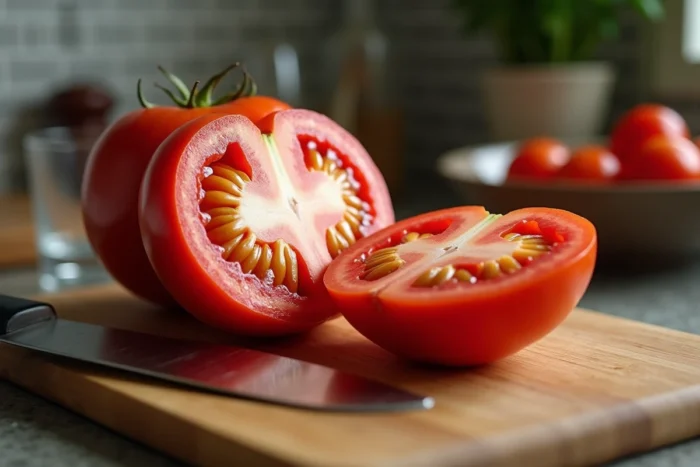
Acting on tomato skin requires intervention at multiple levels. Variety selection remains the most decisive lever, but cultural practices significantly modulate the final result.
Favor varieties selected for taste
Heirloom varieties and selections oriented towards tasting produce thinner skins. Brandywine, Green Zebra, or Cornue des Andes are regularly cited by gardeners for their mouthfeel. However, these thin-skinned varieties are more susceptible to splitting and blight, which explains their absence from commercial circuits.
The compromise to find depends on each situation. A sheltered vegetable garden (greenhouse, tunnel) protects fruits from excess water and allows for fragile varieties. In exposed open ground, it is better to combine a variety with moderate skin with rigorous watering practices.
Actions that make a difference
- Mulch the base of the plants with at least ten centimeters of thickness to maintain constant humidity and limit thermal shocks at the soil level.
- Water with drip irrigation, preferably in the morning, to provide a regular supply without shocks. Spacing out heavy waterings is more detrimental than a slight constant deficit.
- Moderately prune the base of the plants to improve air circulation, which reduces the risk of fungal diseases without exposing the fruits to excessive direct sunlight.
- Harvest at physiological maturity (the fruit detaches easily) rather than leaving tomatoes on the plant until a deep red, stage where the skin continues to thicken.
The thick skin of tomatoes is never the result of a single factor. It is the accumulation of varietal genetics, watering regime, and soil balance that determines the final texture. A gardener who chooses an appropriate variety, maintains regular watering, and monitors the pH of their soil covers the vast majority of causes. The rest is down to the climate, where the only margin for maneuver remains the growing shelter.