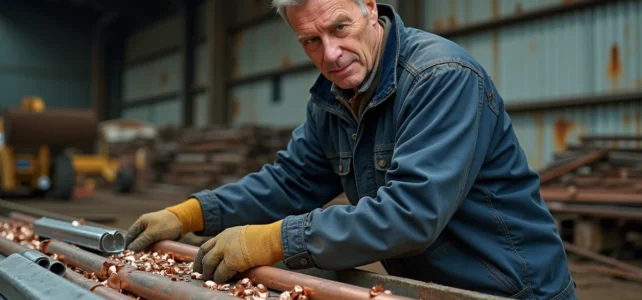
Derichebourg Environment does not publish any metal buyback price list on its website. This is the first point to consider before loading a container with copper or scrap metal: prices are negotiated only in the agency or by phone, on a case-by-case basis, depending on the quality of the lot and the current market rates.
Why Derichebourg does not publish its metal buyback prices
Most independent or regional scrap dealers display an updated price list on their websites. Sar Achat Métaux, Sorevo, Fert Métal, Phénix Recyclage: all offer a table by metal category, updated weekly. Derichebourg operates differently.
The group works with industrial volumes, with long-term valuation contracts with steel mills and foundries. Its pricing policy depends on three simultaneous variables: the global price of the concerned metal (LME for non-ferrous, European indices for steel), the stock level at the receiving site, and the actual quality of the presented lot.
Publishing a fixed price per kilo would mean committing to a basis that can fluctuate by several percent within a few days.
In practice, if you want to know the metal prices at Derichebourg today, the only reliable channel remains a direct call to the nearest agency. We recommend asking for a firm price by phone before traveling, specifying the exact nature of the metal and the estimated tonnage.
Copper, aluminum, and brass prices: what really sets the price per kilo
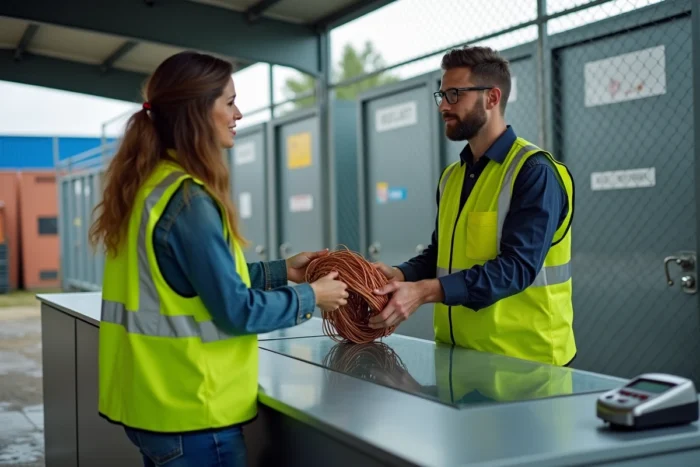
The price you will get from any scrap dealer, including Derichebourg, depends on a simple mechanism: the global price, minus an operational discount. This discount covers sorting, transport, remelting, and the recycler’s margin.
Stripped Millberry copper remains the most valued metal among all operators. At competitors who publish their prices, Millberry copper trades at around ten euros per kilo, with mixed copper slightly below that. Clean brass generally sits around half the price of stripped copper, and bronze falls within a comparable range.
Aluminum shows a much wider price dispersion depending on the sub-category:
- Aluminum rims and white AGS aluminum are bought at the high end of the range, often above one euro fifty per kilo at recyclers who publish prices.
- Aluminum engine blocks and mixed aluminum trade significantly cheaper, around one euro or slightly above.
- Ferrous almelec (aerial cables with a steel core) is found at the bottom of the price list, as the cost of separating steel and aluminum weighs on the buyback value.
At Derichebourg, we observe that the differences between metal qualities are at least as pronounced as with independent recyclers, and even more so in certain categories where the group has specific valuation channels.
Steel and iron scrap: prices by the ton, not by the kilo
Heavy scrap (profiles, beams, thick sheets) and light scrap (appliances, thin bodywork) are not negotiated by the kilo but by the ton. This is a distinction that many individuals are unaware of, and it radically changes the profitability calculation of a trip.
For an individual bringing in a few dozen kilos of scrap, the buyback price of steel scrap remains marginal compared to the logistical effort. Scrap only has real economic interest starting from several hundred kilos, unless you combine non-ferrous metals that are better valued in the same lot.
Electric motors are a special case. They contain wound copper, but their buyback price remains low (a few hundred euros per ton at recyclers who display their rates) because extracting the copper requires costly disassembly. A scrap dealer may decide not to buy certain qualities of motors if their dismantling channel is saturated.
Preparing a lot to maximize the buyback price at a scrap dealer
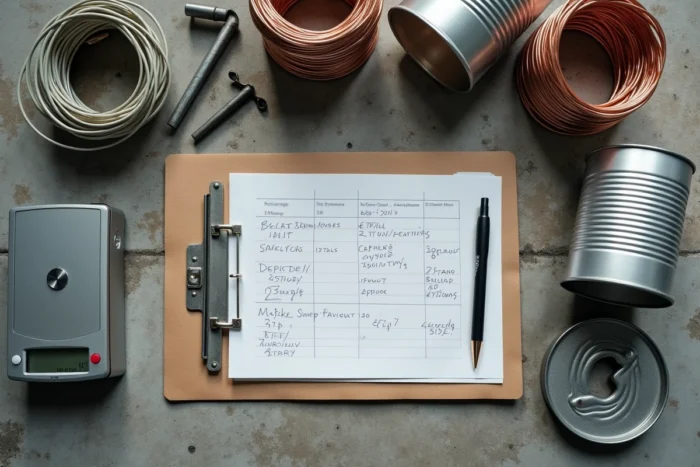
The quality of sorting directly affects the price obtained. Mixing stripped copper with insulated copper in the same bag means getting paid for the entire lot at the lowest rate. Scrap dealers classify by standard category, and any poorly sorted lot is automatically downgraded to the lower quality.
Three preparation rules to always follow:
- Separate ferrous metals from non-ferrous metals. A magnet is enough: what sticks is ferrous, what does not stick is non-ferrous (copper, brass, aluminum, zinc, lead, non-magnetic stainless steel).
- Strip copper cables if the diameter justifies it. A stripped RO2V cable is worth double or triple that of the same insulated cable. Below a certain diameter, the stripping time does not compensate for the gain.
- Remove any foreign parts: brass valves on copper pipes, scrap stuck to aluminum, residual plastic. Each foreign element reduces the classification of the lot.
At Derichebourg, as with any professional recycler, weighing is done on a certified scale. Check the weight of your lot before leaving (a bathroom scale is sufficient for small quantities) to have a rough idea and be able to compare.
Comparing Derichebourg with other scrap dealers: an essential step
The absence of a public price list at Derichebourg makes comparison more laborious, but no less necessary. Before committing, call two or three scrap dealers in your geographic area, describing your lot precisely: type of metal, condition (stripped, insulated, contaminated), estimated weight.
A significant price difference between two scrap dealers for the same metal often indicates a classification difference rather than a scam. One classifies your copper as “mixed,” the other as “Millberry” because their specifications are less strict, or vice versa.
Global prices for non-ferrous metals have remained high in recent times, which mechanically affects buyback prices. A well-sorted lot of copper or brass is currently resold at attractive levels. Steel scrap, on the other hand, offers tighter margins and rarely justifies a trip for small quantities. Focusing your efforts on sorting non-ferrous metals remains the most profitable strategy, regardless of the chosen scrap dealer.